Search Results For "florida"

Dr. Robert J. Rosenstein, 56, Cleveland, Ohio, was indicted one one count of conspiracy to commit bank fraud, false statements to influence a bank to make a loan, mail fraud, and wire fraud. 

Rosenstein is charged as being a straw buyer for a co-conspirator, not charged in the information, referred to as “J.C.” The information defines a straw buyer as an individual who, usually for compensation or other benefit, would sign mortgage loan documents to conceal from the lending institution the fact that someone else, usually a person with poor credit, was going to be the de facto owner of the property and that the straw buyer, although he or she signed the mortgage application and note, had no intention of making mortgage payments or living in the mortgaged property as his or her residence.

The information charges that Rosenstein entered into an agreement with J.C, whereby J.C., through his various companies and entities, would make any and all mortgage payments for Rosenstein if he agreed to act as a straw buyer and sign applications, HUD-1 forms and other documents, used to secure mortgage loans using Rosenstein‘s credit to purchase properties located in Florida. J.C. also paid Rosenstein $25,000 as an inducement to fill out the paper work and to provide his credit to secure mortgage loans. Rosenstein, and J.C. agreed that J.C. would manage and/or develop the property to enhance its value, pay all expenses, including monthly mortgage loan payments, and, once the property was sold, they would split all profits equally.

The information further charges as part of the conspiracy, that Rosenstein executed false loan applications, HUD-1 forms and other documents for two mortgage loans totaling approximately $2.9 million to purchase properties located in the Panama City, Florida area. The mortgage loans were determined to be false based upon the following reasons: 1) The HUD-1 form indicated that Rosenstein would be responsible for the repayment of the loans by making scheduled, monthly payments to the banks when, in fact, based upon his agreement with J.C., Rosenstein, had no intention at the time he executed these documents to be personally responsible for these loans or to make monthly loan payments as required by the mortgage notes; 2) Rosenstein and J.C. indicated on HUD-1 forms that Rosenstein made down payments of approximately $181,767.00 to First Horizon Bank and approximately $44,787.00 to National City on the purchase of these properties, when, in fact, these down payments were never made; 3) J.C. and Rosenstein falsely inflated bank account balances, assets and income on mortgage loan applications in order to assure Rosenstein‘s approval for the loans; 4) The applications indicated that the properties were to be second residences for Rosenstein when, in fact, he never saw or had any plans to live in these properties. Rather, Rosenstein considered these transactions to be an investment and the properties were to be sold within a short period of time and the profits split with J.C., according to the charge.

According to the information, on or about May 2006, J.C. stopped paying the mortgage payments for his straw buyers, and the mortgage loans went into default and foreclosure, resulting in a loss, or charge off, of $811,087.00 for First Horizon Bank and $1,163,148.69 for National City Bank, for a total loss of $1,974,235.69.

The investigation is ongoing.

An information is only a charge and is not evidence of guilt. A defendant is entitled to a fair trial in which it will be the government’s burden to prove guilt beyond a reasonable doubt. If convicted, the defendant’s sentence will be determined by the court after review of factors unique to this case, including the defendant’s prior criminal record, if any, the defendant’s role in the offense and the characteristics of the violation. In all cases, the sentence will not exceed the statutory maximum and in most cases it will be less than the maximum.

Steven M. Dettelbach, United States Attorney for the Northern District of Ohio, announced the indictment.

The case is being prosecuted by Assistant U.S. Attorneys Christian H. Stickan, Mark S. Bennett, and Henry F. DeBaggis, following investigation by agents of the IRS-CI,

and FBI, Akron Office.


The Homeownership Preservation Foundation (HPF), which administers the Homeowner’s HOPE Hotline 1-888-995-HOPE to provide comprehensive financial education and foreclosure prevention counseling, received 145,993 calls in September from distressed homeowners, a three percent increase from the previous month. Call volume to the hotline increased 7.4% in the third quarter from the previous quarter. The states with the largest call volumes in September were California, Florida, New York, Texas and Georgia.

Homeowners who are dealing with foreclosure or the potential of foreclosure need an independent, neutral resource who can help them navigate their financial challenges,” said Colleen Hernandez, CEO of the Homeownership Preservation Foundation. “The Homeowner’s HOPE Hotline’s dedicated team has already helped more than four million homeowners with the myriad of issues surrounding foreclosure, including foreclosure avoidance, comprehensive financial education and reporting foreclosure scams.”

In the past two quarters, we’ve seen an increase in call volume possibly due to the actions servicers have taken through letter campaigns to suggest that homeowners call our hotline. New Public Service Announcements designed by the U.S. Treasury and Fannie Mae featuring real homeowners who have benefited from the Making Home Affordable program, probably increased volume,” said Hernandez. You can see this campaign by visiting http://www.995hope.org/your-stories/

Callers to the Homeowner’s HOPE Hotline, staffed by over 600 HUD-approved housing counselors, have the option to participate in HPF’s five-step process, geared to help them deal with the reality of their financial situation and move toward sustainable homeownership, and if possible, to provide an opportunity to work with their servicer to avoid foreclosure. The five steps are:

  1. A counselor will listen to the caller and in context of the call, elicit as much information as possible to aid in resolution
  2. A counselor will review the caller’s finances
  3. The caller and counselor will explore options for getting help with avoiding foreclosure
  4. A counselor will present the caller with a plan for action
  5. A counselor may connect the caller with their servicer, depending upon the caller’s unique situation

Highlights of September call data to 1-888-995-HOPE include the following:

  • Total calls in September 2010: 145,993
  • Total calls year to date: 1,202,517

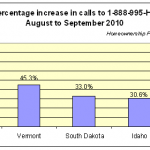
Largest percentage increase in calls from August to September 2010

  • North Dakota 76.2%
  • Vermont 45.3%
  • South Dakota 33.0%
  • Idaho 30.6%
  • Kentucky 20.7%

Largest percentage decrease in calls from August to September 2010:


  • Colorado -9.0%
  • Oregon -8.8%
  • North Carolina -8.4%
  • South Carolina -7.4%
  • Montana -3.4%

Greatest total call volume in September 2010:

  • California 24,722
  • Florida 13,970
  • New York 8,800
  • Texas 7,648
  • Georgia 6,970

Highlights of third quarter call data to 1-888-995-HOPE include the following:

  • Total calls in Q3 2010: 412,353

Largest percentage increase in calls from Q2 to Q3:

  • South Dakota 51.1%
  • New York 45.9%
  • Mississippi 30.8%
  • Georgia 27.8%
  • South Carolina 26.7%

Greatest total call volume in Q3:

  • California 71,744
  • Florida 39,183
  • New York 24,538
  • Texas 21,532
  • Georgia 20,804

For charts of the September and third quarter call volume data, please contact Diane Zyats at dzyats@995hope.org or call 202-480-2775.

888-995-HOPE National Activity – Calls by State – 2010 (PDF)

John Jackson, 42, Hamden, Connecticut, was sentenced by United States District Judge Christopher F. Droney in Hartford to six months of home confinement and two years of probation for participating in a mortgage fraud scheme. Judge Droney also ordered Jackson to pay restitution in the amount of $100,000.

According to court documents and statements made in court, in 2006, Jackson conspired with a New Haven, Connecticut-based real estate attorney and an East Hartford, Connecticut-based mortgage broker to defraud Mortgage Lender Network USA, Inc., a Florida corporation with offices in Middletown, through the purchase of a residential property in Meriden, Connecticut. Working with the attorney and mortgage broker, Jackson signed a loan application provided by the mortgage broker for a loan in the amount of $280,000. Both Jackson and the mortgage broker knew that application contained several material misrepresentations, including Jackson‘s true financial condition.

The application also falsely represented the purchase price of the property, which was substantially less than reflected on the loan application; that the property was to be Jackson‘s primary residence, when it was not; Jackson‘s total liabilities, which were much higher than represented on the application, and that Jackson would provide approximately $60,000 in cash at the loan closing.

On approximately July 21, 2006, as part of the scheduled loan closing, Mortgage Lender wired approximately $283,000 into the attorney’s trust account. At the closing, Jackson signed a HUD settlement statement, which was prepared by the attorney, that overstated the actual purchase price of the property by more than $150,000, and that stated that Jackson had made an earnest payment toward the purchase. In fact, Jackson had not made a payment. Instead, the attorney had made a payout to Jackson.

On July 29, 2010, Jackson pleaded guilty to one count of conspiracy to commit wire fraud.

David B. Fein, United States for the District of Connecticut, announced the sentence.

This case is being investigated by Federal Bureau of Investigation and the Connecticut State Police. The case is being prosecuted by Assistant United States Attorney Christopher W. Schmeisser.


Peter Bakowski, 59, Tampa, Florida, the mastermind behind a $20 million mortgage fraud related Ponzi scheme, was sentenced to 188 months (15 years, 8 months) in federal prison and ordered to pay $16.1 million in restitution.

According to court documents, Bakowski was a licensed mortgage broker at the time he perpetrated his scheme, misusing his credentials to sell the same mortgage to multiple victims. In order to keep the Ponzi scheme going Bakowski would pay returns to the preceding investors with money from new investors. More than 30 victims were affected, including investors and institutions, and more than 150 properties involved. Many of the investors were elderly.

Florida Office of Financial Regulation (OFR) Commissioner Tom Cardwell and United States Attorney Robert E. O’Neill commend the teamwork which resulted in the conviction and sentencing of Bakowski.

Bakowski‘s promises of returns between 10-15 percent are a perfect example of the tactics used by fraudsters to entice investors,” warned Commissioner Cardwell. “It is a reminder that, as consumers looking to invest our hard-earned dollars, we need to adhere to the warnings that if it sounds too good to be true, it probably isn’t true.”

United States Attorney O’Neill stated, “Mortgage fraud has plagued many areas of Florida, and this sentence is a clear sign that those responsible for breaking the law are being held accountable. We will continue to work with state and local law enforcement to vigorously prosecute these types of crimes.”

“Because of the teamwork between our offices, we were able to uncover and prove Mr. Bakowski’s wrongdoings,” said Commissioner Tom Cardwell. “Together we were able to put an end to his victimization and bring him to justice.”

This case was investigated by the OFR Bureau of Financial Investigations and the United States Secret Service. It was prosecuted by Assistant United States Attorneys Thomas N. Palermo and Patricia Willing.

Peter Bakowski, 59, Tampa, Florida, has been sentenced by U.S. District Judge Virginia Hernandez Covington to one hundred and eighty eight months (15 years 8 months) in federal prison for false statements related to a ponzi-type mortgage fraud scheme. He was also ordered to pay $16.1 million in restitution.

According to court documents, Bakowski was a Florida-licensed mortgage broker. Since 2004, Bakowski was doing multiple sales of the same mortgage to more than one person. In order to keep the ponzi-type scheme afloat, Bakowski would pay returns on the preceding investor’s investments with money from that of subsequent investors. There were more than thirty victims affected, to include investors and institutions and more than one hundred and fifty properties involved. Many of the investors were elderly.

United States Attorney Robert E. O’Neill announced the sentence.

United States Attorney O’Neill stated, “Mortgage fraud has plagued many areas of Florida and this sentence is a clear sign that those responsible for breaking the law are
being held accountable. We will continue to work with State and Local law enforcement to vigorously prosecute these types of crimes.”

“This case is another example of the benefits of State and Federal law enforcement addressing the problem of mortgage related fraud,” said John W. Joyce, Special Agent in Charge, United States Secret Service. “By combining our resources we hope to have further successes in combating this fraud that is affecting many of us individually and the economy as a whole.”

“Because of the teamwork between our offices we were able to uncover and prove Mr. Bakowski’s wrongdoings and bring him to justice,” said Commissioner Tom Cardwell. “Bakowski’s promises of returns between 10-15 percent are a perfect example of the tactics used by fraudsters to entice investors and a reminder that, as consumers looking to invest our hard earned dollars, we need to adhere to the warnings that if it sounds too good to be true, it probably isn’t tue.”

This case was investigated by the Office of Financial Regulation (OFR) Bureau of Financial Investigations (BFI) and the United States Secret Service. It was prosecuted by Assistant United States Attorneys Thomas N. Palermo and Patricia Willing.

Wells Fargo Bank has entered into a settlement that provides loan modifications for residents in Washington and seven other states who obtained problematic mortgages from Wachovia Bank and Golden West Corp., which did business as World Savings Bank.

At least 400 Washington borrowers who received payment option adjustable-rate mortgages will be eligible for loan modifications that will provide more than $29 million in mortgage relief, McKenna said. This sum includes nearly $12 million in principal forgiveness for Washington homeowners.

The agreement to be filed in Pierce County Superior Court is the latest in a series of efforts by the attorneys general to help struggling homeowners. It also includes $1.6 million for a foreclosure relief fund to be paid to the Washington Attorney General’s Office. The money could be used to provide refunds to individuals who lost homes or to assist with the state’s efforts to prevent or mitigate foreclosures. An additional $200,000 is allocated to reimburse the office for legal costs.

The Washington Attorney General’s Office served on the executive committee that negotiated the agreement with Wells Fargo, which purchased Wachovia and acquired its subsidiary, Golden West, at the end of 2008. The states claimed that “Pick-A-Pay” loans offered by Wachovia and Golden West/World Savings Bank violated consumer protection laws because they expose borrowers to substantial economic risks that weren’t adequately disclosed.

Wells Fargo, which acquired the unfair loans during bank takeovers, began offering assistance to consumers before the state stepped in. The bank has already completed modifications for 500 Washington residents that save those borrowers more than $31 million.

Pick-A-Pay loans offered borrowers a choice of four payment options: (1) a minimum payment that doesn’t cover the interest due; (2) an interest-only payment; (3) a 15-year amortizing payment; or (4) a 30-year amortizing payment. Most borrowers chose option 1, the minimum payment.

Pick-A-Pay loans “recast” when either the unpaid balance reached a given predetermined percentage of the original loan (usually 110 percent or 125 percent), or when 10 years elapsed. Once the trigger happens, the borrower loses the range of payment choices and must make fully amortized payments under the current – substantially higher – adjustable rate.

The states alleged the companies did not fully explain that the minimum payment due in the first years of the loan did not cover the full amount of accrued interest, resulting in negative amortization. Borrowers eventually faced higher monthly payments and larger loan balances.

Washington Attorney General McKenna announced the settlement.

“The relief offered by this agreement with Wells Fargo comes at a critical time for borrowers who are underwater and their neighbors, whose housing prices would be adversely affected by a foreclosure next door,” McKenna said.

“Borrowers were encouraged to believe their home values would continue to appreciate, making it easy to refinance or sell the home at a gain,” Assistant Attorney General Dave Huey explained. “As we know, the bubble burst.”

Overall, loan modifications will be offered to 8,715 eligible borrowers in the eight states: Arizona, Florida, Colorado, New Jersey, Washington, Texas, Illinois and Nevada. The agreement will save borrowers $772 million.

The agreement provides for a compliance monitor and quarterly reporting to the eight attorneys general.

PROGRAM ELIGIBILITY AND ASSISTANCE:

The agreement provides that between Dec.1, 2010, and June 30, 2013, Wells Fargo will offer modifications to qualified borrowers who are either 60 days delinquent or facing imminent default. Borrowers will first be considered for the federal Home Affordable Modification Program (HAMP). If the borrower cannot qualify under HAMP or elects not to accept a HAMP modification, Wells Fargo will consider the borrower for its new modification program, known as MAP2R.

Modified loan terms will vary according to the circumstances of the borrower but can include principal forgiveness, loan extension, interest rate reduction and principal forbearance (which gives the borrower additional time to pay off the loan principal). Borrowers who remain current on their modified payments over three years will be able to earn additional principal forgiveness. Borrowers who qualify may also convert into a fixed-rate loan.

Under the agreement, Wells Fargo also makes a number of substantial servicing commitments for borrowers with pay option loans. These include:
• Ensuring adequately staffed help lines to serve consumers, including those who speak Spanish.
• Providing a single, primary point of contact to assist borrowers seeking modifications under the states’ agreement.
• Making decisions on modifications within 30 days of receiving a complete application.
• Establishing a formal second look or appeal process for borrowers who are turned down for a modification.
• Offering other foreclosure alternatives, including short sale, deed-in-lieu and relocation assistance.

Wells Fargo customers who originally took out mortgages through Wachovia or Golden West/World Savings Bank can call 1-888-565-1422 for more information about the program.

A report issued in August by the State Foreclosure Prevention Working Group, a multi-state coalition, found that recent loan modifications are performing better. However, 6 out of 10 seriously delinquent borrowers are not getting any help. McKenna encouraged Washington residents facing foreclosure to call the Washington State Homeownership Information Hotline at 1-877-894-HOME (4663) or visit the Attorney General’s Web site at www.atg.wa.gov/foreclosure.aspx for additional resources. He cautioned that loan modifications aren’t miracle cures and not every homeowner will qualify.

James B. Hayes, 57, Boca Raton, Florida, an attorney, pled guilty to a criminal information charging him in two counts of making false statements on a HUD-1 Settlement Form, a matter within the jurisdiction of the U.S. Department of Housing and Urban Development (HUD) in violation of Title 18, United States Code, Section 1001.

According to the criminal information and statements made in court during the plea hearing, Hayes practiced law during 2007 through December 2009 at James B. Hayes P.A., Boca Raton, Florida, handling real estate closings for clients and mortgage lenders. According to statements made in court, during that time, Hayes misappropriated more than $2,706,346.91 that were to be used to payoff prior loans and clients funds from his law firms trust account. Instead of using the money as directed on several closings, Hayes prepared and sent false HUD-1 Real Estate Settlement Forms on closings, falsely reflecting the old loans had been paid off.

As part of the plea agreement announced in court, Hayes agreed to make mandatory restitution of the $2,706,346.91 to the title insurance companies and to the client victims. Hayes was permanently disbarred by the Florida Supreme Court on August 24, 2010 and in his plea agreement agreed to never reapply or seek admission as an attorney in any state.

Sentencing is scheduled for December 3, 2010 at 9:00 AM before U.S. District Court Judge James Cohn in Fort Lauderdale. Hayes faces a maximum statutory sentence of up to five years in prison on each count.

Wifredo A. Ferrer, United States Attorney for the Southern District of Florida, Henry Gutierrez, Postal Inspector in Charge, U.S. Postal Inspection Service, John V. Gillies, Special Agent in Charge, Federal Bureau of Investigation, Miami Field Office, and J. Thomas Cardwell, Commissioner, State of Florida Office of Financial Regulation, announced the guilty plea.

Mr. Ferrer commended the investigative efforts of the U.S. Postal Inspection Service, FBI, and the State of Florida Office of Financial Regulation. Mr. Ferrer also thanked the title insurance companies, Attorneys Title, Old Republic and Chicago Title, for their assistance in this investigation. This case is being prosecuted by Assistant U.S. Attorney Jeffrey H. Kay.


Darryl Stanley Paxton, Jr., a/k/a David Sosa, 34, Broward County, Florida, formerly of Maryland, on charges of wire fraud, money laundering, and fraudulent use of a Social Security number in connection with a scheme to defraud lenders of over $1.8 million, using a false identity. The indictment was returned on July 14, 2010 and unsealed upon the arrest of the defendant in Broward County, Florida, on state charges there.

According to the 15-count indictment, between 1997 and 2007 Paxton utilized the identification, including the Social Security numbers of a man and woman, both of whom had the initials DEB. During that period of time, Paxton began to use the fictitious identity, David Sosa, creating or obtaining a fraudulent Virginia driver’s license purportedly issued on May 12, 1999, in the name of David Sosa. Paxton also created or obtained Georgia and District of Columbia driver’s licenses in the name of David Sosa and on June 23, 2003, was issued a Maryland driver’s license in that name.

The indictment alleges that from September 2005 through August 2007, Sosa obtained over $1.8 million in loans from four lenders by submitting fraudulent loan applications, including a fictitious name, a misappropriated Social Security number, false information about his employment, income, address and ownership of real estate. According to the indictment, Paxton utilized a portion of the loan proceeds to repay part of the previous loans, but left most of the loans substantially unpaid.

For example, by submitting a fraudulent loan application, Paxton allegedly obtained a loan for $620,000 to purchase a property in Cockeysville, Maryland, then repaid that loan with the proceeds of a $1.4 million loan and a $420,000 loan he fraudulently obtained from another lender to refinance that property. The indictment alleges that Paxton then defaulted on those loans, causing a loss to the lender of $900,000.

The indictment alleges that through this scheme, Paxton fraudulently obtained over $2.85 million in loans and caused losses to the lenders of over $1.8 million, which is the amount the government seeks to forfeit.

The indictment further alleges that Paxton used the proceeds of the loans for his personal benefit, including the purchase of a Lamborghini and other luxury automobiles, as well as purchases at Nordstrom, Neiman Marcus, The Plastic Surgery Center, the Big Screen Store, and others.

Paxton faces a maximum sentence of 30 years in prison for wire fraud; a maximum of five years in prison for fraudulent use of a Social Security number; and a maximum of 10 years in prison on each of five counts of money laundering. Paxton is detained on state charges in Florida pending his transfer to U.S. District Court.

An indictment is not a finding of guilt. An individual charged by indictment is presumed innocent unless and until proven guilty at some later criminal proceedings.;

The indictment was announced by United States Attorney for the District of Maryland Rod J. Rosenstein; Special Agent in Charge Richard A. McFeely of the Federal Bureau of Investigation; and Special Agent in Charge Michael McGill of the Social Security Administration – Office of Inspector General, Philadelphia Field Division.

The Maryland Mortgage Fraud Task Force was established to unify the agencies that regulate and investigate mortgage fraud and promote the early detection, identification, prevention, and prosecution of mortgage fraud schemes. This case, as well as other cases brought by members of the Task Force, demonstrates the commitment of law enforcement agencies to protect consumers from fraud and promote the integrity of the credit markets. Information about mortgage fraud prosecutions is available at www.justice.gov/usao/md/Mortgage-Fraud/index.html.

This law enforcement action is part of President Barack Obama’s Financial Fraud Enforcement Task Force. President Obama established the interagency Financial Fraud Enforcement Task Force to wage an aggressive, coordinated, and proactive effort to investigate and prosecute financial crimes. The task force includes representatives from a broad range of federal agencies, regulatory authorities, inspectors general, and state and local law enforcement who, working together, bring to bear a powerful array of criminal and civil enforcement resources. The task force is working to improve efforts across the federal executive branch, and with state and local partners, to investigate and prosecute significant financial crimes, ensure just and effective punishment for those who perpetrate financial crimes, combat discrimination in the lending and financial markets, and recover proceeds for victims of financial crimes.

United States Attorney Rod J. Rosenstein thanked Assistant U.S. Attorney Mara B. Zusman, who is prosecuting the case.


Robert Policastro, 57, most recently of Vienna, Austria, was sentenced to five years and three months in federal prison for conspiracy to commit mail and wire fraud (mortgage fraud). The court also entered a money judgment in the amount of $9,082,394.20, the proceeds of the mortgage fraud conspiracy. Policastro had pleaded guilty on May 17, 2010.

According to court documents, Policastro, who was an architect, conspired with a Florida licensed title agent to commit mortgage fraud. Policastro took out primary loans to buy several million-dollar properties in Miami, and then, without the knowledge of the primary lender, obtained a “silent second” loan on each property. The “silent seconds” financed Policastro‘s down payments for the properties and allowed him secretly to take money out of the deals. To hide the “silent seconds,” the title agent prepared false, “dueling” HUD-1s to send to both the primary and the “silent second” lenders so that each was unaware that Policastro had obtained two loans on each property. The loans were closed in Pinellas County.

U.S. Attorney A. Brian Albritton announced the sentencing.

This case was investigated by Federal Bureau of Investigation. It was prosecuted by Assistant United States Attorney Thomas N. Palermo.

This case is a part of the Middle District of Florida’s Mortgage Fraud Initiative, a joint effort by the U.S. Attorney’s Office and federal, state, and local law enforcement agencies throughout the Middle District of Florida. It is a “Phase II” case, brought following the initial wave of Mortgage Fraud Initiative prosecutions, the Mortgage Fraud Surge, which occurred over ten months in 2009 and netted more than 100 defendants. Phase II of the Mortgage Fraud Initiative seeks to build upon the Surge, expanding upon surge leads and techniques to uncover and prosecute increasingly complex mortgage frauds.

Peter N. Price, 49, Hollywood, Florida, was sentenced on Friday, August 27, 2010, by U.S. District Court Judge James Cohn to 46 months in jail, to be followed by three years of supervised release. The Court also ordered Price to pay $1,712,766.92 in restitution to Stewart Title Guarantee Inc.

Price was charged with making false statements to HUD, in violation of Title 18, United States Code, Section 1001. According to the criminal information and statements made during plea hearing, Price, a title attorney, operated Intracostal Title Services, Inc., a title company in Hollywood, Florida. According to statements made in court, Price embezzled more than $1,608,246.57 in loan proceeds from his escrow account on real estate closings he was handling on behalf of clients. This money was sent to Intracostal‘s escrow bank account by clients to pay off prior mortgage loans. Instead of using the money as directed, Price prepared and sent a false HUD1 Real Estate Settlement Form, falsely reflecting the old loans had been paid.

Wifredo A. Ferrer, United States Attorney for the Southern District of Florida, Henry Gutierrez, Postal Inspector in Charge, U.S. Postal Inspection Service, John V. Gillies, Special Agent in Charge, Federal Bureau of Investigation, Miami Field Office, and J. Thomas Cardwell, Commissioner, State of Florida Office of Financial Regulation, announced that defendant

Mr. Ferrer commended the investigative efforts of the U.S. Postal Inspection Service, FBI, and the State of Florida Office of Financial Regulation. This case is being prosecuted by Assistant U.S. Attorney Jeffrey H. Kay.